기업
ReCerise Presents Mechanism of “New Target” TM4SF5 Antibody in AACR Oral Session
by Juyeon Lee
TM4SF5-targeting antibody ‘RCT1213’ shows synergy with ICIs via “TME modulation”; IND submission targeted by end of next year
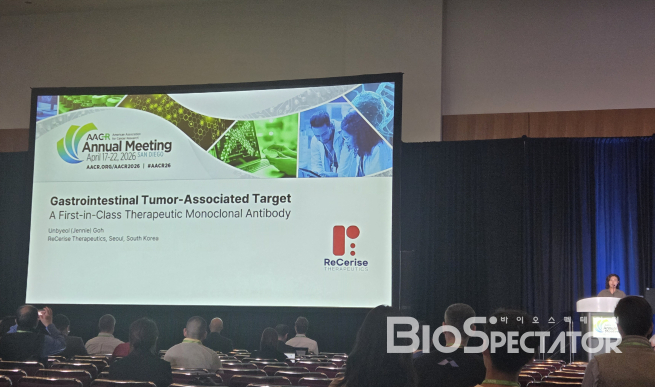
▲ReCerise Therapeutics give an oral presentation in AACR 2026
ReCerise Therapeutics is developing a first-in-class antibody targeting the novel transmembrane protein TM4SF5 and is preparing to advance the drug candidate into clinical trials as early as next year.
TM4SF5, first identified in pancreatic cancer (PDAC) in 1998, is a four-pass transmembrane glycoprotein known to be highly expressed in gastrointestinal cancers such as hepatocellular carcinoma (HCC), colorectal cancer (CRC), and PDAC. Through its TM4SF5-targeting antibody ‘RCT1213,’ ReCerise aims to reprogram the tumor microenvironment (TME), which is resistant to immune responses, into one that enables immune activity.
On April 20 (local time), ReCerise delivered an oral presentation at the American Association for Cancer Research (AACR 2026), highlighting the target mechanism and preclinical results of RCT1213.
Unbyeol (Jennie) Goh, Head of Business Development at ReCerise, stated, “TM4SF5 is not merely an expression biomarker in gastrointestinal cancers, but a target protein involved in tumor progression and immune evasion.”
According to the company, TM4SF5-enriched microdomains (T5ERM) mediate protein–protein interactions (PPI) on the cancer cell surface, interact with the IL-6 receptor to regulate T-cell cytokines and chemokines via the STAT3 pathway, and interfere with NK cell recognition through association with the transmembrane protein SLAMF7—collectively contributing to the formation of an immunosuppressive TME.
Clinical data further show that patients with high TM4SF5 expression in HCC or CRC have nearly 50% lower overall survival (OS) probability compared to those with low expression. RNA sequencing and real-world data also indicate increased levels of immunosuppressive Treg cells and M2 macrophages, alongside reduced CD8+ T cells and NK cells.
In such TME conditions, immune checkpoint inhibitors (ICIs) are less effective; for example, the overall response rate (ORR) in gastric cancer remains below 20%.
To address this, ReCerise is developing RCT1213 to restore the TME and enhance ICI efficacy. RCT1213 works by masking the epitope of TM4SF5, reducing pSTAT3 signaling to block tumor metastasis and invasion, while increasing NK cell activation receptors to enhance cytotoxicity. The antibody also incorporates a Fc-enhanced domain that boosts effector function by binding to Fc gamma receptors (FcγR) on immune cells. Notably, it simultaneously binds to both EC1 and EC2 regions of TM4SF5.
ReCerise reports that RCT1213 has a binding affinity in the 0.1–0.2 nm range and demonstrated increased TM4SF5-specific cell binding in vitro in HCC cell lines.
In vivo CRC humanized models showed increased effector T cells (Teff) and reduced Treg proportions. These effects translated into synergistic outcomes when RCT1213 was combined with PD-1 antibodies. Notably, in HCC allograft model, combination therapy with RCT1213, a PD-L1 antibody, and a VEGF antibody achieved a 100% complete response (CR), according to the company. Additionally, a colorectal cancer patient-derived xenograft (PDX) model showed an average tumor growth inhibition (TGI) rate of 63.8%.
Goh added, “RCT1213 does not directly target oncogenic proteins but improves the TME, enabling synergistic effects when combined with ICIs.”
The company aims to submit an investigational new drug (IND) application for RCT1213 targeting TM4SF5-expressing solid tumors by the end of next year or early 2028.
In parallel with asset development, ReCerise is also advancing diagnostic methods using TM4SF5 expression as a biomarker, with the goal of predicting treatment response and identifying optimal patient populations.